We quote houses in Prune Hill, Fisher’s Landing and Felida in the same week, and the conversations are barely related. Same region, same utility rules, same sunshine: three different problems.
This is what a location page cannot tell you, and it is why a desktop quote built from an aerial photograph so often misses.
Prune Hill, Camas: the shade conversation
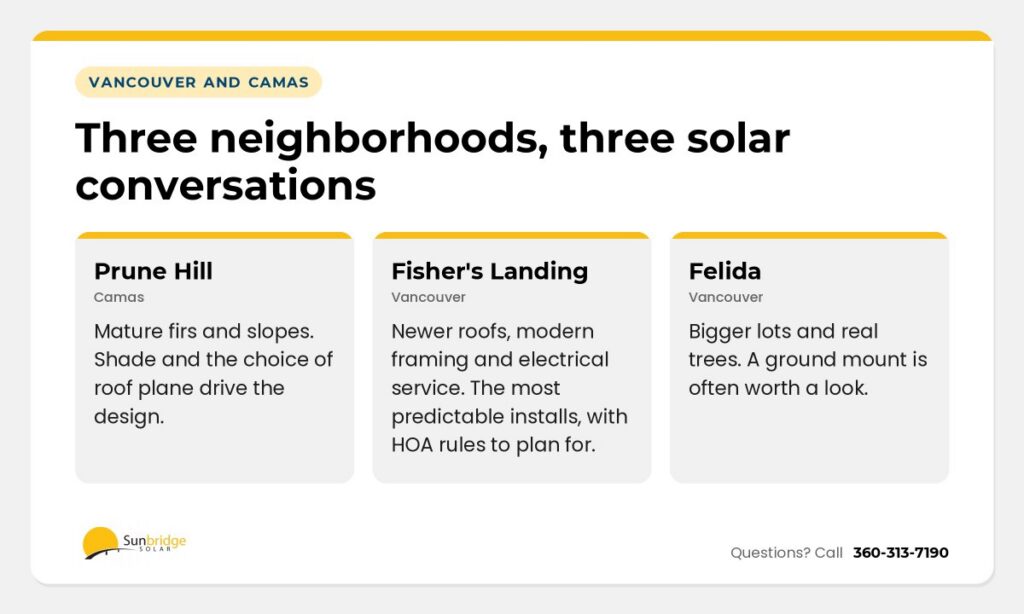
The hill is the appeal and the complication. Homes here tend to be newer and larger with good, modern roof structure and healthy electrical service (the easy part), but they sit among mature Douglas fir, and the terrain itself adds shading that flat ground does not.
The design question here is almost always which plane rather than how many panels. A full-year shade model matters more than usual, because a treeline that clears the roof in July can lie across it at midday in December. On a slope, that geometry is less forgiving.
When the main roof is compromised, the answer is frequently a garage or a secondary plane rather than a smaller array on the wrong surface.
Fisher’s Landing, Vancouver: the straightforward one
East Vancouver’s newer subdivisions are, in our experience, the most predictable installs we do. Roofs are young enough to have plenty of life left, framing is modern and consistent, electrical service is usually adequate for a solar breaker without drama, and the plan shapes repeat, which means we have often seen your roof before.
The constraints here are subdivision constraints. Plans repeat, so roof planes are often smaller and busier with vents and dormers than the square footage suggests. And where a homeowners association is involved, appearance conditions apply. It is worth knowing that Washington law voids outright solar bans, though associations may still set reasonable placement and appearance rules.
Felida, Vancouver: bigger lots, older systems, real trees
North of Vancouver the lots open up and the picture changes again. Larger parcels put ground mounts genuinely on the table, which is rarely true in a subdivision. Older homes mean the electrical panel gets inspected before anyone talks about system size. And the tree cover is substantial and often not yours.
The most common Felida conversation is whether the best surface is the house at all. A shop or detached garage with a clean southern exposure will beat a shaded house roof every time, and the cost that decides it is the trench between the array and the meter rather than the panels themselves.
What actually varies, and what does not
Across all three, the things that change are shade, roof age, service capacity and whether you have room for a ground mount. The things that do not change are the utility rules, the permitting sequence and the physics.
That is why we survey rather than estimate. Fifteen minutes in an attic and on a roof tells us more than any aerial image, and it is the difference between a firm price and a revision after installation day.
Frequently Asked Questions
Why do solar quotes differ so much between Vancouver neighbourhoods?
Because shade, roof age, electrical service and available ground differ enormously across a few miles. Utility rules and permitting are constant; the house is not, which is why a site survey beats a desktop estimate.
Is Prune Hill good for solar?
Often, but shade drives the design. Homes there tend to have modern structure and service, while mature firs and sloping terrain mean the choice of roof plane matters more than the number of panels. A full-year shade model is essential.
What makes newer east Vancouver subdivisions easier?
Young roofs, modern framing and adequate electrical service, with repeating house plans we have often seen before. The constraints are smaller, busier roof planes and, where applicable, homeowners association appearance rules.
Should a Felida home use a ground mount?
Frequently worth considering, because the lots are large enough for it and tree cover often compromises the house roof. The deciding cost is usually the trench and conductor run back to the meter rather than the array itself.
Can my Washington HOA stop me installing solar?
No. Washington law makes prohibitions in governing documents void, though associations may still impose reasonable placement and appearance conditions. Designing for approval is straightforward when it is planned from the start.
Want to know which conversation your house is?
Call 360-313-7190. We will look at the roof and the attic, not a satellite photo. Sunbridge Solar serves Camas, Washougal, Vancouver, Portland and the Columbia River Gorge.