
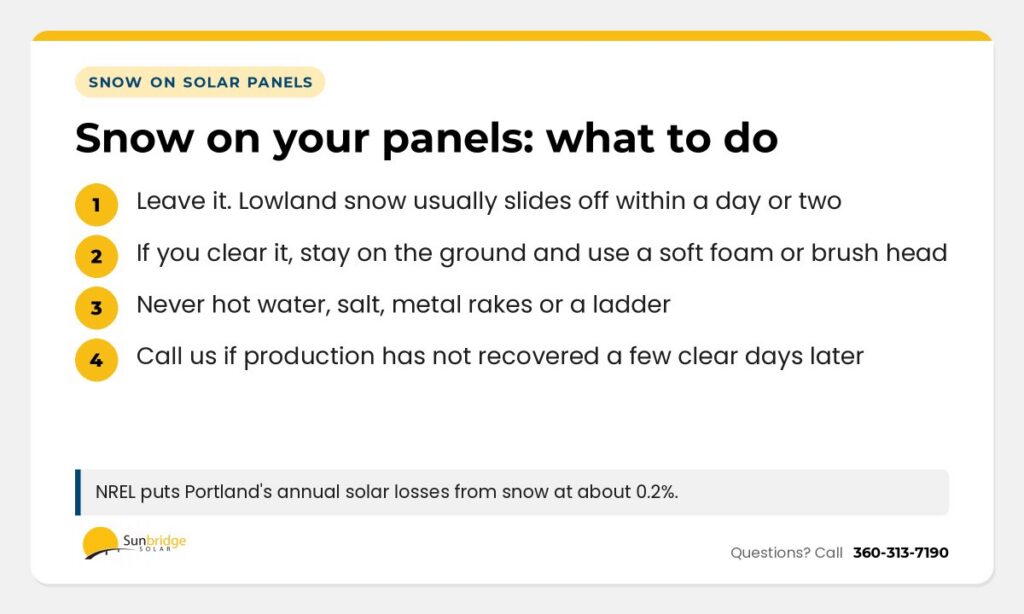
Leave it, in almost every case. Snow on solar panels in Vancouver, Camas and Portland usually slides off or melts within a day or two of the sun coming back, because the panels are smooth dark glass set at an angle. Sunbridge Solar recommends clearing snow only from the ground, with a soft tool, and never from a ladder.
This is the short guide we give our own customers after the first snow of the winter: what snow actually costs you, how to clear it safely if you decide to, what never to put on the glass, and the handful of things that are worth a phone call.
How much production does snow cost in the Portland area?
Very little over a year. The National Renewable Energy Laboratory modeled snow losses for sites across the country and put Portland at about 0.2% of annual solar production, for both array tilts it tested. Sites in Minnesota and Michigan came in close to 16%. The NREL snow loss study has the full table.
The reason is simple. The lowlands around Portland and Vancouver average only a few inches of snow a year at Portland International Airport, according to National Weather Service climate normals for 1991 to 2020, and it rarely stays for long. Snow also tends to arrive in December and January, the months when a system makes the least power anyway, so a covered array in late December is giving up a slice of an already small number. Our post on whether solar panels work in the winter explains the bigger picture.
Higher ground is different. In the upper Columbia River Gorge and the foothills, snow sits longer and becomes part of the structural design. Our guide to wind, snow and roof structure covers that side of it.
Why does snow slide off solar panels on its own?
Solar panels shed snow faster than the roof around them. The glass is smooth, the panels sit at the pitch of the roof, and even under a thin layer of snow they absorb some daylight and warm slightly. Once the lower edge of an array clears, the dark glass warms in the sun and the rest usually slides off in sheets.
That slide is the one thing worth planning for. Snow leaving an array lands in a heap at the eave, often all at once. On the first sunny afternoon after a snowfall, keep people, pets and cars clear of the eaves below your panels, and think about what sits underneath: a doorway, a walkway or a heat pump unit.
Should you clear snow off your solar panels?
Usually not. Clearing snow buys back a few hours of winter production, which is worth very little in the Portland and Vancouver area, and climbing onto a snowy roof is genuinely dangerous. Sunbridge Solar does not recommend that any homeowner go onto a roof in winter to clear panels.
There are reasonable exceptions, as long as you can do the job standing on the ground:
- A ground-mounted array, where the whole surface is within reach.
- A single-story roof where a long pole reaches the bottom row of panels from the ground.
- Heavy, wet snow that has sat for most of a week with more on the way.
How do you clear snow from solar panels safely?
If you decide to clear snow from solar panels, this is the order we recommend:
- Stay on the ground. Use a telescoping pole. Never use a ladder in snow or ice, and never walk on a roof with panels on it.
- Use a soft head. Foam or a soft-bristled brush made for glass or solar panels. Never a metal roof rake or anything with an edge.
- Work from the bottom edge. Pull small sections down gently. You only need to expose some glass, and the sun does the rest.
- Leave ice alone. Ice bonded to the glass releases on its own. Chipping at it risks the glass.
- Stand clear. Keep out from under the snow you are pulling down, and away from the wiring under the edge of the array.
Before you buy a tool, check what your panel maker’s warranty says about cleaning and snow removal. Scratched or cracked glass from scraping is the kind of damage a homeowner usually ends up paying for. For year-round care, including moss and debris, see our solar maintenance guide.
What should you never use to clear solar panels?
- Hot water. Pouring hot water on cold glass risks cracking it, and the runoff refreezes on the roof and in the gutters.
- Salt, de-icer or other chemicals. They can damage the glass coating, the frames and the roof itself.
- Metal rakes, shovels and ice scrapers. One scratch across the glass is permanent.
- A pressure washer. It can force water past seals and connectors.
- Your own weight. Kneeling or stepping on a panel can crack the cells inside, even when the glass looks fine.
When should you call Sunbridge Solar about snow?
Call Sunbridge Solar at 360-313-7190 if you see any of these after a snowfall:
- Production still near zero two or three clear days after the snow has gone.
- One panel or section that stays dark in your monitoring app while the rest of the array has recovered.
- A panel that looks cracked, shifted or lifted, or a cable hanging below the array.
- Ice building up along the eave below the array, or water showing up inside the house.
- Damage to a gutter or anything else below from sliding snow.
If the problem is a silent app rather than a silent array, check your home internet first. The monitoring gateway goes offline along with your router, and the panels keep producing while it is down.
What about power outages during a snow or ice storm?
Snow and ice storms are when the grid tends to go down around Portland and Vancouver, and a grid-tied solar system switches off during an outage by design, to protect the line crews working on it. Panels on their own do not keep the lights on. If outages are what worries you, a battery is the answer, and our post on what happens when ice snaps the power lines explains how battery backup carries a house through one.
Frequently asked questions
Do solar panels work when they are covered in snow?
Solar panels under a thick layer of snow produce little or nothing until it clears. A light dusting lets some light through, and panels often start producing and warming underneath it. In the Portland and Vancouver lowlands snow rarely stays more than a day or two, which is why it costs local systems so little over a year.
Can snow damage solar panels?
Snow on its own rarely damages solar panels in the Portland and Vancouver area. Panels and racking are rated for snow loads, and arrays at higher elevations are designed to the local building code figure. The real risks come from the tools people use to clear snow, and from snow sliding off the array onto whatever sits below it.
Is it safe to use a roof rake on solar panels?
A roof rake is safe on solar panels only if it has a soft foam or brush head and you use it from the ground. A metal roof rake can scratch or crack the glass. Pull gently from the bottom edge, never climb a ladder in snow, and check what your panel warranty says about snow removal first.
Do I need to do anything to my solar system before winter?
Most solar systems in Southwest Washington and the Portland area need nothing special before winter. It is worth clearing the gutters below the array, trimming branches that could drop onto it, and checking that your monitoring app reports every panel, so you have a clean baseline if something looks wrong after a storm.
Questions about snow, ice or how your system handled the last storm? Call Sunbridge Solar at 360-313-7190 or request a free consultation.