
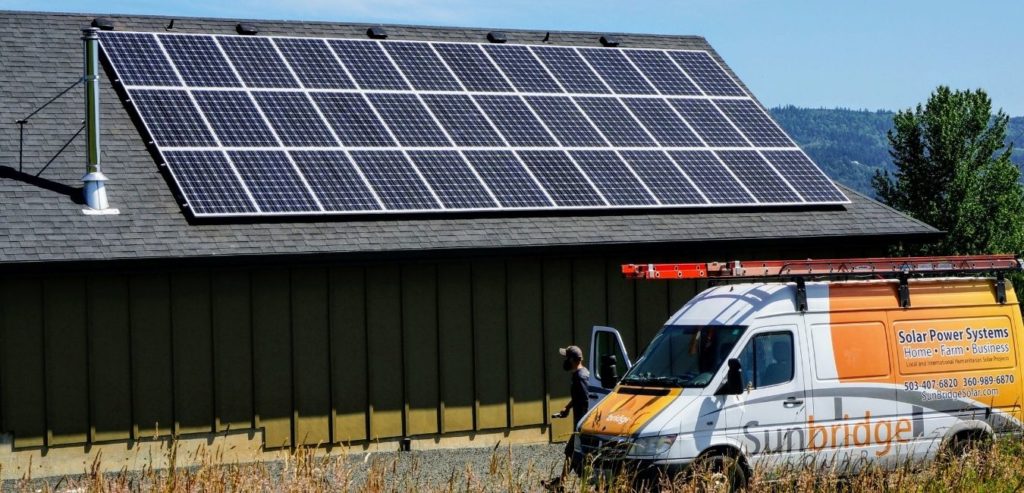
Oregon Solar Panel Guide for Homeowners and Business Owners
Since the Willamette Valley is notorious for cloudy and rainy weather, it may not seem obvious that Oregon is one of the best states for installing home solar panel systems.
In this article, we’ll explore;
how solar in Oregon works
what benefits you can expect, and
how many solar panels you might need
Our team of solar experts here at Sunbridge Solar is here to help, so if you have any additional questions about Oregon solar panels that we didn’t answer in this article, please get in touch with us!
Quick Look: Solar Panels Oregon
You may have already typed in Google, “solar panels Oregon” and done a bit of research, about the different types of solar energy. For a quick refresher, it’s important to distinguish that there are two types of solar panels: photovoltaic (PV) panels that produce electricity and solar thermal panels that are used to generate heat. For the purposes of this article, we will solely be looking at photovoltaic solar panels. Most solar companies in Oregon – as well as here at Sunbridge Solar – install only PV panels and not thermal solar panels.
Essentially, a solar panel collects photons (particles of light) from the sun, which then knock electrons free from atoms within the panel materials, which generates an electrical current.
Each solar panel is actually a frame that contains many individual solar cells. If you have multiple solar panels wired together, that constitutes a solar array, and when the array is connected to batteries, inverters, and your home’s wiring, it becomes a solar energy system.
Grid-Tied Vs. Off-Grid Systems
Grid-tied systems are installed on homes that are already connected to a local energy utility grid, for the purpose of reducing energy costs and providing backup power in the case of a grid outage. If your solar energy system creates more electricity than you use in a month, you can usually take advantage of net metering, which allows you to amass credits for the excess energy you produce, which can be applied to your energy bills in subsequent months when your energy production is lower or your consumption is higher. If your system does not produce as much energy as you use, you will simply be charged the difference for grid electricity.
Off-grid systems are primarily used in very remote or rural settings where no utility connection exists. They are designed to charge a battery system, which then provides power at night or whenever the solar panels are not generating power.
Read More: Off-Grid Solar: How to Go Off-Grid in the Modern Era
Are Solar Panels in Oregon Efficient?
Solar panels are very efficient, especially in Oregon. There are several factors that affect the efficiency of solar panels, but we’ll explore the four biggest factors.
Sunlight
The first and most obvious factor is the amount of sunlight that hits the solar panel. Of course, this will vary during different seasons, since the days are significantly longer and generally sunnier in the summertime in Oregon when compared to winter days. However, solar panels do not need direct sunlight to produce energy, so even on cloudy or overcast days, they will still generate some electricity.
Temperature
Next up is the average temperature of the area. Solar panels lose efficiency the hotter it is, and actually have a temperature coefficient rating, which essentially indicates the percentage of power generation loss for each degree Celsius above 25 degrees Celsius (77 degrees Fahrenheit). Fortunately, Oregon is not exceptionally hot, so solar panels tend to do well and generate power efficiently here.
Types of Solar Panel in Oregon
The type of solar panel you select also dictates the overall efficiency of your system. Each model of solar panel has an efficiency percentage rating that’s generally between 15-20%, although some newer panels have ratings as high as 22%. The current drive in the solar panel industry is to improve the efficiency of panels while still keeping the costs reasonable.
Read More:
Angle and Orientation
Finally, the angle at which your solar panels are mounted has a significant impact on efficiency. Solar panels work best when the sun is hitting them straight-on. Obviously, the optimal angle to achieve this varies throughout the year, but here in the northern hemisphere, the sun will always be to the south, so mounting solar panels on a pitched south-facing roof surface is the most effective.
If you want to maximize your energy production, you can design your mounting system to be adjustable so that you can change the panel angle throughout the year.
Where Does Solar Work Best in Oregon?
Solar works across the whole state, but it behaves differently on each side of the Cascades. Eastern Oregon gets more sun. Western Oregon gets more cloud, and modern panels handle that better than most people expect. If you are in the metro, start with our Portland solar panel installation page.
Solar in Eastern Oregon
Eastern Oregon sees more sunny days and higher solar irradiance than the west side, which makes it strong ground for solar production.
- Strong production. More sunny days on average than Western Oregon means more kilowatt-hours from the same size array.
- Room to scale. Wide-open rural land suits larger arrays, and agricultural and commercial operations can cut utility costs meaningfully.
- Worth planning around. High winds and wide temperature swings are harder on equipment, and some remote sites need extra work at the utility connection.
Solar in Western Oregon
Western Oregon’s rain and gray skies put people off solar, but panels still produce well here, and the cooler temperatures actually help.
- Cloudy is not dead. Panels capture diffuse light on overcast days, which is why solar works in the cloudy Pacific Northwest.
- Cool runs efficient. Panels lose efficiency as they heat up, so Western Oregon’s mild summers work in your favor.
- Shade is the real variable. Tree cover matters more than rainfall here, which is why we measure Total Solar Resource Fraction on your specific roof instead of quoting from a map.
How Much Sun Does Your Oregon City Get?
Solar resource varies across the state. Here is how five Oregon cities compare on average daily solar resource and sunny days per year:
| City | Solar Resource Value (kWh/m²/day) | Number of Sunny Days |
|---|---|---|
| Portland | 4.5 | 144 |
| Bend | 5.2 | 158 |
| Eugene | 4.3 | 155 |
| Salem | 4.6 | 150 |
| Medford | 5.0 | 195 |
These are averages for the area, not for your address. Pitch, orientation, and shade move the number in both directions, which is why we measure your specific roof before quoting a system size. You can also run a quick estimate with our Oregon solar calculator.
How Many Solar Panels Do You Need?
This depends entirely on your household. A good way to decide what size of the system is appropriate for your home is to determine your current electricity consumption, assessed at different times of year – people generally have the lights on more in the winter and use energy to heat their homes, and don’t use as much energy in the summer unless they are running air conditioning units.
You can find your consumption amount in kWh on your current energy bill to help find out how many solar panels you will need to power a house.
100% Offset Using Just 13 To 33 Solar Panels
Then decide how much of that energy consumption you can feasibly cover by analyzing your roof’s capacity for holding solar panels and the number of sunshine hours the panels will receive.
In general, each kW of solar panels will require 100 square feet of south-facing roof space. Residential solar energy systems commonly range from about 4 kW to 10 kW to generate 100% of the home’s energy consumption or 13 to 33 solar panels to offset your consumption by 100%
Are Solar Panels Worth It in Oregon?
Installing a solar energy system at your home is definitely worth it.
A Few Advantages
Solar power provides a clean, renewable, emission-free energy source, which is critical in today’s environmental crisis. Installing solar panels will significantly reduce your carbon footprint, something we all need to strive to protect the planet.
Nowadays, solar installations in Oregon are increasingly affordable, especially with federal, state, and local incentives. Most solar energy systems have a lifespan of about 25 years, and many systems will pay themselves off within 10-12 years, so you will get to enjoy free or very low-cost clean energy for over a decade.
Solar energy also increases your home equity by an average of $14,000, so even if your plans change and you end up moving out of your home before the solar energy system has reached the end of its lifespan, you can get most or all of your initial investment back.
You can also set up your solar energy system to provide backup power in the case of a grid outage, which will keep you comfortable and prevent the food in your refrigerator from spoiling every time the power goes out.
A Few Disadvantages
There are very few disadvantages of solar panels. One may be that the initial investment costs are significant, but even this large expense can be cut by up to 50% by taking advantage of all the federal, state, and local solar incentives.
It could also be argued that solar panels are unsightly, but manufacturers are making increasingly sleek and unobtrusive panels that blend right into your roof. Tesla is also working on photovoltaic roof tiles that would be indistinguishable from regular solar roof tiles.
Is It Worth Getting Cheap Or Free Solar Panels?
In general, no. If you are going to spend the money to invest in a solar energy system, you will be much better off long-term if you invest in high-quality panels and other solar components. However, as we’ve mentioned, high-quality equipment doesn’t necessarily have to break the bank. Plus, it is now easier than ever to obtain financing for your solar project, so you can spread out the cost over several years.
Cheap solar panels are likely to be less efficient, less durable, and have a shorter lifespan than better quality panels, so you may end up spending more money on maintenance and repairs than you would have on one set of high-quality panels that do not require much maintenance.
Oregon Solar Incentives
Oregon homeowners still have real ways to bring the cost of a system down, cash rebates from Energy Trust of Oregon and several utility programs, calculated on a per-watt basis, plus statewide net metering.
Additionally, there are several Oregon solar incentives that give cash-rebates for residents of various Oregon cities and utility service areas on a per-watt basis, and a state-wide net metering program that allows you to get credit on your energy bill for excess energy that you sell back to the grid.
List of Oregon Solar Incentives
- Energy Trust of Oregon Solar Incentives
- Portland General Electric Solar Program
- Pacific Power Solar Incentive Program
- Solar Within Reach
- ODOE Solar Rebate for Battery Backup Systems
- Oregon Net Energy Metering
- Portland Clean Energy Fund
- USDA REAP Grant (Grants for large solar farms)
What changed federally: the federal residential solar tax credit (Section 25D) ended for systems placed in service after December 31, 2025. The commercial credit runs on its own timeline, so a business project may still qualify. We keep the current picture on our federal solar tax credit update, and anything tax-related is worth confirming with your tax professional.
Incentive amounts and eligibility shift from year to year, so rather than repeat them here we keep one current list on our Oregon solar incentives page.
Read More:
All Oregon Solar Incentives Available This YearShould You Add Battery Backup?
A battery keeps your essentials running when the grid goes down, refrigerator, freezer, medical equipment, a few lights and outlets. It adds cost up front, and in a region with wildfire and earthquake risk, that trade-off is worth thinking through rather than defaulting either way.
- Critical loads stay on. You choose which circuits the battery carries, so the things that spoil or matter most keep running.
- Outages here are not always short. After a windstorm, wildfire, or earthquake, the grid can be down for days rather than hours.
- It pairs with an EV. As more Oregon households add an electric vehicle, solar plus storage plus EV charging starts working as one system.
If you are weighing storage, our home battery backup guide walks through sizing and what a battery realistically covers, and our battery backup service page covers how we install it.
Areas We Serve Near Portland
We install across NW Oregon. City and county guides:
- Portland, our largest Oregon market
- Beaverton
- Hillsboro
- Gresham
- Lake Oswego
- Salem
- Oregon City
- Washington County
- Yamhill County
Oregon Solar Panels FAQ
What are the benefits of installing solar panels in Oregon?
Oregon’s climate is conducive to solar power, with enough sunny days to make systems efficient. Benefits include lower electricity bills, incentives, and contributing to a cleaner environment.
Is Oregon a good state for solar energy?
Yes, despite its reputation for rain, Oregon gets ample sun for solar energy production, and the state encourages solar adoption through incentives and rebates.
What incentives are available for solar panel installation in Oregon?
Oregon has several: Energy Trust of Oregon cash rebates, utility programs such as Pacific Power and Portland General Electric, Solar Within Reach for income-qualified households, and statewide net metering. The federal residential credit (Section 25D) ended for systems placed in service after December 31, 2025. The commercial credit runs on a separate timeline. Check the current Oregon incentives page and confirm anything tax-related with your tax professional.
How does net metering work in Oregon?
Net metering allows solar panel owners to sell excess electricity back to the grid, earning credits that can offset future utility bills.
How much does it typically cost to install solar panels in Oregon?
It depends on system size, equipment, and how complex your roof is. Most Oregon homes land somewhere in the $10,000 to $20,000 range, and state or utility incentives can bring that down further. We give you a firm number after looking at your roof and your power bills rather than quoting from a range.
How long do solar panels last in Oregon?
On average, solar panels can last 25 to 30 years, with minimal maintenance.
Can I install solar panels myself in Oregon?
DIY installation is not recommended due to safety concerns, warranty issues, and complexity. Professional installation is advised.
Will solar panels increase the value of my home in Oregon?
Yes, homes with solar installations often see an increase in property value, making them attractive in the real estate market.
What size solar system do I need for my home in Oregon?
The size depends on your energy usage and roof space. An assessment by a solar provider can give you an accurate estimate tailored to your needs.
Do I need a permit to install solar panels in Oregon?
Yes, you’ll typically need a building, electrical permit, and sometimes county permits. Unlike some other companies, Sunbridge solar will handle this process for you.
What Makes Us Different?
At Sunbridge Solar, we take great pride in providing a specialized and individualized method for installing solar panels. Since every house and business is different, we take the time to get to know our customers and their individual energy requirements. Your energy goals, financial constraints, and property are carefully considered by our solar experts as they design and install a solar panel system for you.
Furthermore, we put a high priority on honesty and transparency in everything we do. Throughout the entire process, from the initial consultation to the last installation, we believe in being honest and upfront with our clients. We help our clients navigate the various solar incentives that are available while providing detailed information about the costs and advantages of solar energy.
As part of our ongoing support, we also keep an eye on your system’s performance, respond to your inquiries, and perform maintenance. Our dedication to offering top-notch customer service and premium solar solutions that are tailored to each client’s specific needs is ultimately what distinguishes us from the competition.
Get a Free Quote
We aim to make the process as simple and transparent as we can because we recognize that switching to solar energy can be a significant investment. We give our clients free quotes so they can get an accurate idea of the costs and savings associated with installing solar panels on their property. Our team of professionals will collaborate with you to create a solar solution that is tailored to your unique energy requirements and price range.
Contact Sunbridge Solar right away if you want to find out more about installing solar panels in Oregon and receive a free estimate. In order for you to make an informed decision about going solar, our team is available to answer any questions you may have and give you the information you require. We are eager to assist you in switching to clean and renewable energy!