2026 equipment update. The SunPower that made these panels no longer exists. SunPower Corporation filed for Chapter 11 in August 2024; its brand and some assets were bought by Complete Solar, which later renamed itself SunPower Inc. The new company did not take on warranties for systems installed on or before September 30, 2024. If you own SunPower panels, the section at the end of this article tells you exactly who to contact. The review below is kept as a record of how these panels performed.
What You Need to Know About SunPower Solar Panels
SunPower was started in 1985 as EOS Electric Power. In 1988 the solar panel manufacturer was renamed SunPower 1988. The company received funding to begin manufacturing solar cells in 1990 and began shipping them out to customers in 1992.
A Result-Driven Company
Since then, the company has expanded exponentially and its products have been used in some record-breaking applications, such as the World Solar Challenge race across Australia and a NASA high-altitude world record flight (video below).
SunPower produces some of the most efficient solar panels available on the market today and they are backed with an exceptional 25-year warranty. In this article, we’ll take a look at all of the important details about these solar panels and what makes them special.
Most solar companies look and sound the same but SunPower has a unique story to tell. It was our collaborations with pioneers such as NASA and Solar Impulse
Where Are SunPower Solar Panels Made?
SunPower has been headquartered in Silicon Valley in California since its inception, and although they have manufacturing plants in both Hillsboro, US, and the Philippines, they are based in the United States.
Additionally, SunPower has recently decided to turn their manufacturing division into a new company altogether called Maxeon Solar, while SunPower will exclusively focus on installing the solar panels.
SunPower Will No Longer Manufacture Solar Panels
SunPower is splitting its business into two. SunPower will now focus only on the consumer and service side while the new company – Maxeon Solar – will continue to be a solar panel manufacturer. The split was initiated by a $298 million investment by SunPower’s long-time partner and a world-leading supplier of silicon wafers, Tianjin Zhonghuan Semiconductor Co. (TZS).

Why The Debut Of Maxeon Solar?
The aim is to streamline the two companies’ core operations without mingling the two. “This transaction will also simplify both organizational structures, lowering costs, while improving efficiency and creating more nimble companies,” said SunPower CEO Tom Werner during a November 11 conference call.
Maxeon Solar will take over the production and technology innovation giving SunPower the ability to focus solely on expanding their market share against their competitors, like Canadian Solar.
How Much Are SunPower Solar Panels?
SunPower panels do cost more than most other options due to their premium quality and through-the-roof space efficiency. However, the prices aren’t outrageous by any means – SunPower systems cost on average between $2.97 per watt and $3.67 per watt, compared to the market average of $2.91 per watt.
That means that you could expect to pay on average between $17,820 and $22,020 for a standard 6 kW solar energy system that incorporates SunPower panels. However, keep in mind that local, state, and national solar incentives can dramatically reduce this cost – by several thousand dollars in many cases!
On its own, the federal investment tax credit for solar power will save you 26% of the total cost of installation in the form of deductions against your federal tax liability amount. This can be coupled with applicable rebates, grants, and other incentives to significantly reduce the upfront cost to you.
Types Of SunPower Solar Panels
SunPower has four lines of solar panels that are optimized for different applications. Let’s take a look at each of them.
A-Series
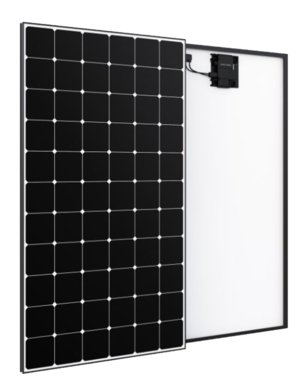
With the A-Series solar panels, SunPower introduced the world’s first 400-watt solar panel, capable of producing more power than ever before in a smaller space.
The A-Series panels use Maxeon Gen 5 solar cells, which are 65% larger than previous generations, which means they can convert significantly more sunlight into electricity while taking up less space overall. These panels have efficiency ratings of up to 22.3%, putting them well above the average of 15-20%.
X-Series
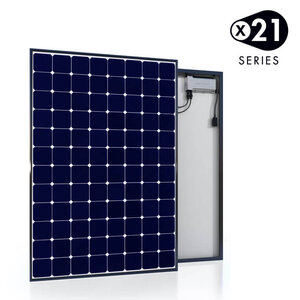
The X-Series offers up to 22.8% efficiency and up to 370 watts per panel for residential panels and up to 470 watts for commercial panels. These state-of-the-art panels are 60% more efficient over 20 years, producing an average of 45% more energy in year 1 and an average of 80% more energy in year 25 when compared to conventional panels.
The highly efficient panels deliver 44% more power per panel than traditional panels as well, which means fewer panels on your roof and more power. The all-black panels are constructed with anti-reflective glass to help them blend right into your roof and complement a wide variety of architectural and roof styles.
E-Series
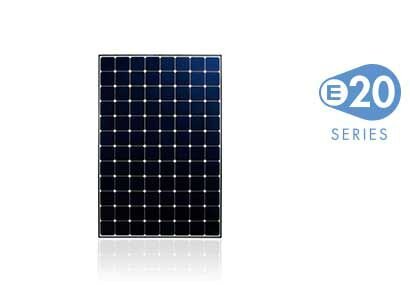
SunPower’s E-Series delivers up to 20% efficiency and comes in 320, 327, or 435-watt options. These panels are the workhorses of SunPower’s lineup, designed to deliver consistent, worry-free energy over an exceptionally long lifespan.
P-Series
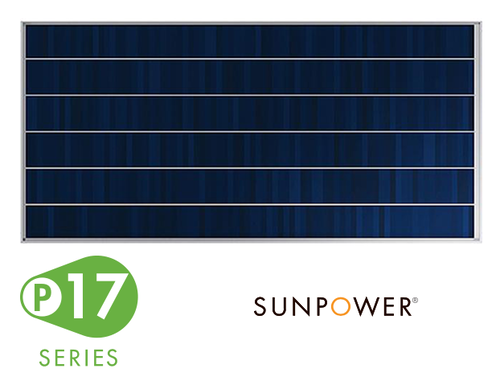
The P-Series are built with SunPower’s unique shingled solar cells and deliver up to 19% efficiency in panels that range from 380 to 400 watts. P-Series panels are designed for large commercial projects and they are engineered for maximum reliability and efficiency.
What Makes SunPower Solar Panels Different?
SunPower panels outstrip the competition in terms of efficiency, power, and warranty, but that’s not all that sets them apart.
Integrated Solar Panel + Inverters
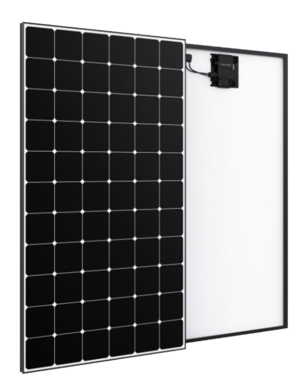
SunPower’s A-Series panels come with integrated microinverters built-in, which means that the DC energy produced by the panel is converted into AC energy (what your home appliances and lights use) right there on the panel. This eliminates the need for a string inverter elsewhere in the system and boosts production at the source, which means that these solar panels produce more power per square foot than any other solar panels that are commercially available today.
All-In-One System
This all-in-one system means that there is no need for a large inverter elsewhere. Additionally, this system of micro inverters is advantageous over traditional string inverter setups because each panel is functioning individually with its own inverter, so the whole system doesn’t suffer a production drop if just one panel is shaded.
Next-Generation Design
SunPower has really raised the solar technology bar with this advancement, allowing panels to function independently and more efficiently while also eliminating the need for the additional component of an inverter. As we mentioned in the A-Series description, these panels use SunPower Maxeon Gen 5 solar cells, which are 65% larger than previous generations of the solar cell and offer a much higher conversion rate. Additionally, the panels are beautifully styled to blend seamlessly into your roof with a sleek, high-end aesthetic.
SunPower Warranty Vs. Conventional Warranties
SunPower offers a long-term industry-leading 25-year product warranty against any defects in their products, which exceeds the standard warranty period of 10 years for most solar panels. This 25-year warranty is the gold standard that gives buyers peace of mind that they will be protected against nearly any kind of problem that could arise.
The SunPower Complete Confidence Warranty includes the following, which is not covered by conventional solar panel warranties: complete system protection, removal of a defective part and installation of a new part, and shipping. Additionally, the SunPower warranty guarantees a 25-year DC power decline of no more than 8%, while traditional warranties allow for as much as a 19.3% decline.
Are SunPower Solar Panels The Best?
SunPower solar panels do take first prize in nearly every metric for evaluating solar panels. One such metric that we haven’t covered yet is the performance of SunPower panels in terms of the temperature coefficient.
What Does the Temperature Coefficient Mean?
A temperature coefficient indicates how well a panel will perform in suboptimal conditions, which, as for most electronics, includes very hot temperatures. In general, solar panels perform best when they are 25 degrees Celsius (77 degrees Fahrenheit) or cooler, and their production rates begin to drop as the temperature increases above that benchmark.
The temperature coefficient tells you how much production loss you can expect for each additional degree over 25 degrees Celsius, and is expressed as a negative percentage. Most panels on the market today have a temperature coefficient between -0.3% and -0.5%, and obviously the less production drop, the better. SunPower panels have temperature coefficients ranging from -0.38% to -0.29%, meaning that once again, they are leading the industry.
4 Important Factors To Consider
The four most important factors when evaluating solar panels are efficiency, performance, warranty, and cost. SunPower panels are superior to the vast majority of other panels on the first three out of those four metrics, although they are more expensive than many other options, which leads us to: are SunPower solar panels worth the extra cost?
Are SunPower Panels Worth The Extra Cost?
This answer will be different for everyone based on budget and power needs, but in general, we recommend that SunPower panels are indeed worth the extra cost. If power density, efficiency, and a strong warranty are important to you, then you can’t beat what SunPower is offering.
Additionally, their panels are available in extremely high wattages, so you can power your home or business even if your energy consumption rates are high. In fact, in a recent EnergySage ranking of solar panels, SunPower earned the best and highest reviews of every solar panel brand listed.
However, not everyone needs the absolute best solar panels. If you have plenty of space on your roof and want to keep your budget on the lower end, installing more panels that are slightly less efficient can work out to be more economical and just as effective as going for top-of-the-line SunPower panels. Conversely, if you have limited space and aim to maximize production as much as possible, SunPower panels might be the perfect option for you.
How To Buy SunPower Solar Panels
The easiest way to buy SunPower solar panels for your home or business is to hire a qualified solar installer (like us at Sunbridge Solar) to order and install your panels for you.
A Local Solar Company That Helps You Every Step Of The Way
We will help you with every step of the process, from determining if your property is suitable for solar energy to helping you pick which solar panels are best for your needs, and then guide you through the permitting, purchasing, installation, and inspection processes
We will also help you find any applicable solar incentives that you can take advantage of to keep your out-of-pocket costs as low as possible.
Contact us today to get started with a free consultation and project quote!
Who honours a SunPower warranty in 2026?
This is the question that matters, and the answer depends entirely on one date.
SunPower Corporation, the company that built its reputation on high-efficiency back-contact panels, filed for Chapter 11 bankruptcy on August 5, 2024 and was delisted shortly after. On September 30, 2024, Complete Solar bought the SunPower brand, Blue Raven Solar and parts of the business. In April 2025 that buyer renamed itself SunPower and took back the old stock ticker.
So there is a company called SunPower today. It is not the company that sold most of the SunPower systems in the Portland metro area.
Installed on or before September 30, 2024
The new SunPower did not assume these warranties. Where you go depends on how you paid:
- Cash or loan purchase. Contact your lender. On loan-financed systems the paperwork trail usually runs through the finance company.
- Lease or power purchase agreement. Contact your financier, or SunStrong Management on (833) 514-1858, which administers a large share of the legacy SunPower lease and PPA fleet.
Installed after September 30, 2024, or by Blue Raven Solar
These are handled by the current SunPower Inc. directly, through its warranty portal at us.sunpower.com/warranty.
Your inverters and microinverters are a separate matter
This is the part people miss, and it is usually good news. If your system used Enphase microinverters, an SMA or Fronius inverter, or panels from another manufacturer in a SunPower-branded package, those component warranties are held by those manufacturers and are unaffected by anything that happened to SunPower. An Enphase microinverter warranty is an Enphase obligation. Check what is actually on your roof and in your inverter cabinet before you assume you have no coverage at all.
What this means for a system in the Pacific Northwest
Our region has an unusually large population of these systems. SunPower sold heavily through the Portland metro and Clark County in the 2010s, and the panels themselves were genuinely good, high efficiency, and a back-contact design that handled partial shading better than most of what was available at the time. That mattered here, where a mature Douglas fir two doors down is the single most common cause of underperformance.
Three practical points for an aging SunPower array in this climate:
- Keep producing evidence. Performance warranty claims need production data. If your monitoring was tied to a SunPower app or portal that has changed hands, export or screenshot your history now rather than after something fails.
- Distinguish real degradation from shade and soiling. Output that has fallen over five years in Vancouver or Camas is more often tree growth, moss on a low-pitch roof, or a bad string than panel degradation. Rule those out before you start a warranty claim, because a claim you cannot support wastes months.
- Wildfire smoke is not a defect. Late-summer smoke has measurably cut production across the region in recent years. A poor August does not mean your panels are failing.
If a panel does fail
On a discontinued line, replacement with an identical module is unlikely. A comparable current panel is the normal outcome. On a system with microinverters or optimisers, a mismatched replacement module is a non-issue. On an older string inverter it can matter, and that is worth checking before a panel is swapped rather than after.
The lesson worth taking from this
SunPower was, for years, the brand people bought precisely because it seemed safest. It is now one of four major names to have left this market since 2022, alongside LG, Panasonic and Solaria. Panel quality and company survival turned out to be different questions.
The practical defence is not picking a bigger brand. It is choosing an installer who will still be here to chase a claim on your behalf, and keeping your own paperwork. We have been installing in the Pacific Northwest since 2010.
If you own this equipment and need help: start with the company that installed it, then the warranty administrator named above. They hold the records a claim needs. If Sunbridge Solar installed your system, call us on 360-313-7190 or send us a message and we will handle it from our end.
Is SunPower still in business in 2026?
A company called SunPower exists, but it is not the original manufacturer. SunPower Corporation filed for Chapter 11 in August 2024, and its brand was bought by Complete Solar, which later renamed itself SunPower Inc.
Who honours my SunPower warranty now?
It depends on your installation date. Systems installed on or before September 30, 2024 were not taken on by the new company — cash and loan owners should contact their lender, and lease or PPA customers their financier or SunStrong Management on (833) 514-1858. Systems installed after that date, or by Blue Raven Solar, are handled by the current SunPower Inc.
Are my SunPower panels still safe and working?
Yes. Nothing about a corporate bankruptcy affects panels already on your roof. They keep producing normally, and the practical change is only in how a future warranty claim would be handled.
Does the bankruptcy affect my inverter warranty?
No. Inverter and microinverter warranties are held by their own manufacturers, such as Enphase, SMA or Fronius, and are unaffected by what happened to SunPower.
Should I replace my SunPower panels?
Almost never on warranty grounds alone. If the array is producing well, replacing working panels is expensive and pointless. The time to reconsider is when the roof needs replacing anyway or you are expanding the system.
My production has dropped. Is that panel degradation?
Usually not. In this region the common causes are tree growth, moss on low-pitch roofs, a failed optimiser or microinverter, and summer wildfire smoke. Those should be ruled out before pursuing a degradation claim.
Own a SunPower system in Clark County or the Portland metro and want a straight assessment of it? Call us at 360-313-7190 or request a free quote.