
A home battery keeps your heat, refrigerator, Wi-Fi and medical equipment running when an ice storm takes down the lines. Solar panels on their own shut off in an outage for line-crew safety. A battery paired with solar islands your home from the dead grid in a fraction of a second, then recharges from your panels, even in gray winter light.
Key takeaways
- The grid is genuinely vulnerable here. Freezing rain and heavy ice are hard on overhead lines, and a serious Columbia River Gorge or Willamette Valley ice storm can knock out neighborhood power for days.
- Solar panels alone will not keep the lights on. Grid-tied systems without a battery shut off automatically when the grid goes down. That is a safety requirement, not a malfunction.
- A battery changes that. It detects the outage, disconnects your home from the dead grid and keeps your critical circuits running.
- Winter sun is weaker, not useless. Short, overcast December days still give your panels enough light to put some charge back into a battery between outages.
- The federal residential credit has ended. The 30% federal residential clean energy credit does not apply to systems placed in service after December 31, 2025. Oregon and Washington programs still exist, so check what applies to your address.
If you have spent even one winter in the Columbia River Gorge, you already know the sound. It is not the soft hush of snowfall. It is the sharp crack of ice-loaded branches, followed by the blue flash of a transformer somewhere down the road. East winds pouring through the Gorge turn a routine freezing rain event into a serious ice storm, and the damage does not stop at Washougal city limits. Camas, Vancouver and the Portland metro feel it too, and every few winters the Willamette Valley gets hit just as hard.
How long can an ice storm outage last in the Portland and Vancouver area?
An ice storm outage around Portland, Vancouver and the Gorge can last days, not hours. A typical summer outage is a blip: a branch or a squirrel, and power is back within the hour. Ice storms are different. When freezing rain coats every branch and wire across the region at once, utility crews face hundreds of outages at the same time, treacherous roads and repairs that happen one downed line at a time.
For most households that means a cold house, a spoiling fridge, no internet and no way to charge phones. For anyone relying on a CPAP machine, home oxygen or an electric heat pump, it can become a genuinely dangerous situation.
Why don’t my solar panels work during a power outage?
Grid-tied solar panels without a battery shut off during a power outage because of a required safety standard. This is the misconception Sunbridge Solar hears most often from homeowners who already have panels: they assume the array means they are covered in a blackout. They are not.
When the grid goes down, utility crews go out to repair downed lines. If your panels kept feeding electricity onto those lines, they could injure or kill a lineworker working on what they believe is a dead wire. So your inverter switches off the instant it senses a grid outage. For the full explanation, see whether solar panels work without utility power.
Is a generator or a plug-in battery kit good enough for an ice storm?
A gas generator or an off-the-shelf battery kit can help, but both have real drawbacks in a Pacific Northwest ice storm. Once homeowners realize panels alone are not enough, the next instinct is often one of the two.
A gas generator needs fuel you have to store, refill and run outdoors away from windows. That is not easy when your driveway is a sheet of ice and the gas stations nearby have no power to pump. Generators are loud, most need manual startup, and nothing happens overnight unless someone is awake to manage it.
Off-the-shelf battery kits have a different problem: cold. Most residential batteries use lithium iron phosphate (LFP) cells, which are safe and long-lasting but charge slowly, or not at all, when the cells get too cold. A battery mounted on an exterior wall or in an unheated shed can lose much of its winter usefulness right when you need it most.
What happens when the power goes out with a home battery?
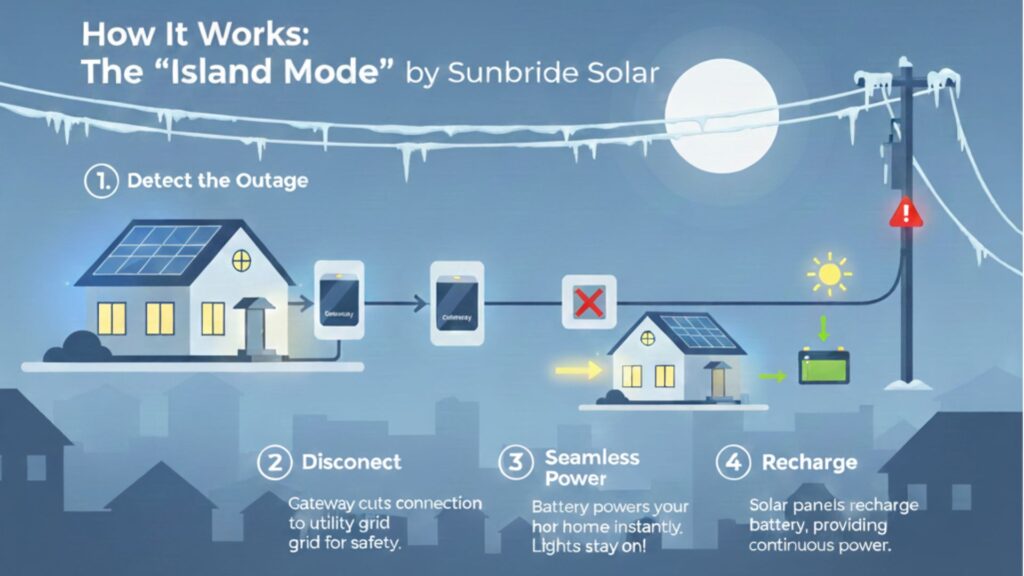
With a home battery backup system, four things happen in sequence the moment a branch takes down the line outside your house:
- Detection. The battery’s gateway senses the drop in grid voltage within a fraction of a second.
- Islanding. A transfer switch disconnects your home from the dead utility grid, so your home can use its own power without endangering line crews.
- Switchover. The battery starts powering your backed-up circuits, usually so quickly that most households barely notice the change.
- Recharge. Once daylight returns, even weak overcast light, your solar panels send power into the battery for the next night.
How does Sunbridge Solar design battery backup for PNW winters?
Sunbridge Solar designs battery backup around winter outages, because that is when Washougal, Camas and Vancouver households actually lose power. We have been installing solar in this climate since 2010. Where the house allows it, we place batteries in an insulated garage or basement rather than on an exterior wall, and we check each battery’s cold-weather operating limits as part of the design.
We are Energy Trust of Oregon verified, we back every install with a 10-year craft warranty and 25-year product warranties, and a typical residential install takes one to three days on site, with no pressure to buy more system than you need. See our home battery backup service for how we approach it, or the Home Battery Backup Guide for sizing, chemistry and critical-load planning in detail.
What should a home battery power during an ice storm?
A home battery should power the circuits that keep your household safe, not the whole house at full blast for three sunless days. When Sunbridge Solar designs a system, we build a critical loads panel that typically covers:
- The refrigerator, so a week of groceries does not spoil
- The furnace blower, to keep the house warm and pipes from freezing
- Wi-Fi and phone charging, for emergency updates
- Medical equipment such as CPAP machines or oxygen concentrators
High-draw items like electric dryers, hot tubs and ovens usually stay off the critical panel so they do not drain your reserve in an afternoon. If you live out toward Stevenson or Cathlamet, read how Gorge wind and snow load change solar design as well.
When should I start if I want a battery before winter?
Start before the first ice advisory, because permits, equipment orders and utility interconnection approval can take several weeks in our experience. Homeowners across Washougal, Camas and Vancouver who call once the forecast turns are already behind. The right time is well before the season’s first hard freeze.
Frequently asked questions
Will a solar battery recharge during a Pacific Northwest winter?
A solar battery does recharge during a Pacific Northwest winter, just more slowly than in summer. Panels run on light, not heat, and cold temperatures actually help panel efficiency. Even under thick December cloud, diffuse daylight puts some charge back into the battery each day.
Can I run my heat pump on battery power during an outage?
A heat pump can run on battery power during an outage, but it draws much more than a gas furnace blower, especially at startup. Homes that need heat pump backup usually need more than one battery, and it is worth raising during your consultation so the system is sized for it.
I already have solar panels. Can I add a battery later?
A battery can be added to an existing solar system later. This is a common retrofit: a battery and gateway are connected into your current system without replacing your panels. Sunbridge Solar quotes batteries alongside new solar or as a separate job afterward.
How long will a home battery power my house in an outage?
How long a home battery lasts in an outage depends on what it is powering. Running only the essentials, such as the refrigerator, furnace blower, lights and a few outlets, a properly sized battery can carry a household through an overnight outage and recharge from solar the next day.
Are there still incentives for adding battery storage in 2026?
The 30% federal residential clean energy credit does not apply to systems placed in service after December 31, 2025, so it no longer covers new 2026 installs. Oregon and Washington have their own state and utility programs that change from year to year. Confirm current details, and check with a tax professional before counting on any figure.
Source for the federal credit: IRS, Residential Clean Energy Credit (checked November 2026).
Get ready before the next ice storm
The worst time to think about backup power is the night the forecast turns to freezing rain. Sunbridge Solar builds storm-ready systems for neighbors across Camas, Washougal, Vancouver, Portland and the Columbia River Gorge, with straight answers about what your home actually needs.
Call 360-313-7190 or request a free, no-pressure quote. Want a rough number first? Try the solar calculator.
Sunbridge Solar | 421 C St Ste 5a, Washougal, WA 98671 | 360-313-7190