
2026 equipment update and disclosure. Sunbridge Solar does not install Tesla products. We install Enphase and SolarEdge storage. We have kept this comparison because it is a question people genuinely ask, and an installer with nothing to sell you on either side is arguably the more useful person to answer it. Current specifications for both are below, along with what actually matters in a Pacific Northwest outage.
Living here in Washougal and Camas, we know the drill: The Columbia Gorge winds pick up, the fir trees sway a little too hard, and suddenly, the lights flicker. From the Oregon Coast to the Cascades, power reliability is the new conversation at every neighborhood block party.
If you were here for the windstorm on December 17, 2025, you remember it well. Over 200,000 neighbors in Clark County and Portland were left in the dark—some for nearly a week—right before the holidays. That event was a wake-up call. It wasn’t just “another storm”; it was a reminder of how fragile our grid has become.
At Sunbridge Solar, we get asked one question almost daily: “Which battery is better for the Pacific Northwest: Tesla or Generac?”
In 2026, the landscape has changed. While Tesla gets the headlines, Generac has quietly built the most robust, flexible system for our region. In this guide, we’ll compare the stats and performance of the Tesla Powerwall 3 against the Generac PWRCell 2 to show you why the “underdog” might actually be the heavyweight champion for your home.
(Prefer to chat with a human? Call us at 360-313-7190 for a straightforward, no-pressure conversation.)
The “Grid Gap”: Why You Need a Battery in 2026
Before we talk specs, let’s talk about why this matters right now. It’s not just about storms anymore.
By now, you’ve likely seen the reports from late 2025 about the Pacific Northwest’s energy supply. Due to the rapid retirement of coal plants and the explosive growth of data centers along the Columbia River, regional utilities are forecasting a 3 Gigawatt (GW) energy gap by 2030.
What does this mean for you?
It means that even on calm days, we are facing a higher risk of “rolling blackouts” during peak usage times. A battery isn’t just emotional insurance; it’s essential infrastructure. And for that, you need a system that is built to last.
The Contenders at a Glance
- Generac PWRCell 2: The “Smart” choice. Known for their legendary generators, Generac brings a system that is modular (start small, grow later) and integrates seamlessly with gas generators for indefinite backup.
- Tesla Powerwall 3: The “Viral” choice. Sleek and simple, but often inflexible. It forces you to buy a “one-size-fits-all” block of energy, whether you need that much or not.
1. Aesthetics & Installation Footprint
We find that homeowners in Portland and Vancouver often worry about curb appeal.
Tesla Powerwall 3
- The Look: Slim, white, and minimalist.
- The Reality: It looks great, but form often follows function. The tight packaging makes it harder to service individual components if something goes wrong.
Generac PWRCell 2
- The Look: Industrial and robust. It looks like a high-end server cabinet.
- The Reality: It’s built for work. The cabinet design allows for better airflow and cooling, which is critical for longevity. More importantly, it allows us to open the door and swap out individual components without ripping the entire unit off the wall.
Winner: Tie. (Tesla for looks, Generac for serviceability).
2. Battery Chemistry & Maintainability
This is where Generac’s engineering pedigree shines.
- Generac PWRCell 2: Uses high-density NMC modules.
- The “Service” Advantage: If a single battery cell fails in a Generac system, we can drive out and swap just that one module (which looks like a heavy briefcase) in 15 minutes. You don’t lose your whole system.
- Tesla Powerwall 3: Uses LFP chemistry.
- The “Sealed Box” Problem: While LFP is durable, the Powerwall is a sealed unit. If one internal component fails, the entire unit often has to be removed and shipped back, leaving you with zero backup for weeks or months.
Winner: Generac PWRCell 2 (For superior repairability).
3. Continuous Power: The “Smart Load” Factor
In Washington and Oregon, we rely on Heat Pumps. Starting them up requires a massive surge of power.
Generac PWRCell 2
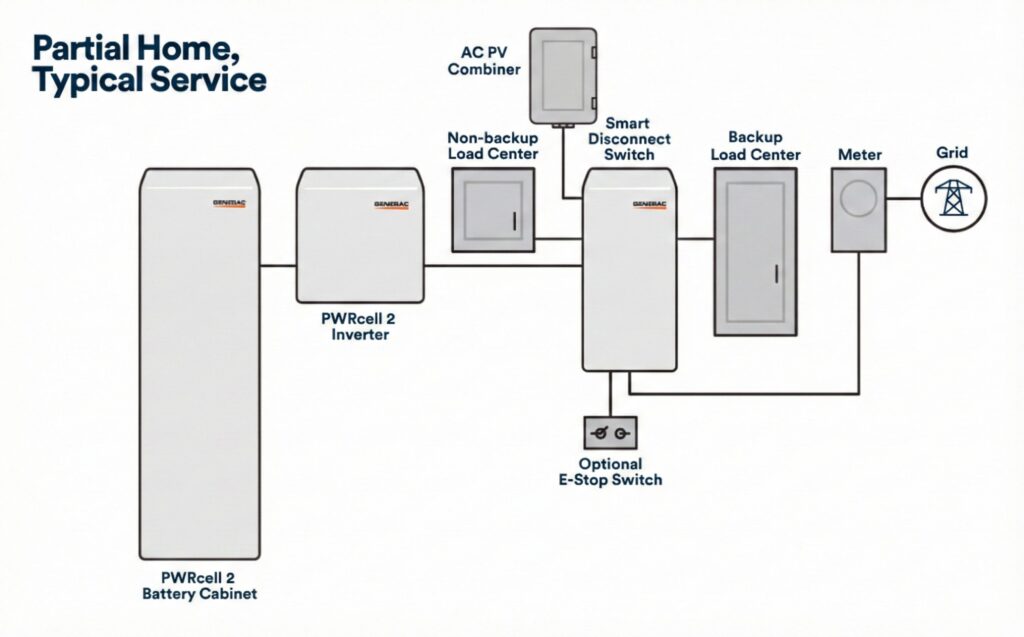
- Smart Management Modules (SMMs): This is Generac’s secret weapon. Instead of just “dumping” power, the PWRCell uses intelligent SMMs to prioritize loads. It can briefly pause your water heater to let your heat pump start, then turn the water heater back on.
- The Result: This smart juggling act allows the PWRCell to back up more of your home with less battery power than competitors.
Tesla Powerwall 3
- Brute Force: Tesla relies on high raw power (11.5 kW) to run everything at once. While impressive, it lacks the nuance of Generac’s load management. If you overload it, the whole house goes dark.
Winner: Generac PWRCell 2 (Smarter management = more reliability).
4. The “EV Charging” Reality
In Washougal and Camas, EVs are everywhere.
- The Generac Approach: Through its smart load management, Generac ensures your EV doesn’t accidentally drain your house battery during an outage. It protects your home’s survival first.
- The Tesla Approach: Tesla integrates well with its own cars, but if you drive a Rivian, Ford Lightning, or Kia, the “Charge on Solar” features are less seamless. Generac is vehicle-agnostic.
Winner: Generac PWRCell 2 (Better protection for your home reserves).
5. Modularity: The “Pay As You Grow” Advantage
This is the #1 reason our customers are switching to Generac in 2026.
- Generac PWRCell 2: Flexible (9 kWh to 18 kWh).
- You can start with just 3 battery modules (9 kWh) to keep the cost down. Did you buy an EV a year later? No problem. We just slide 3 more modules into the existing cabinet. You don’t need a new permit, a new spot on the wall, or a new inverter.
- Tesla Powerwall 3: Rigid (13.5 kWh blocks).
- You buy 13.5 kWh blocks. If you need just a little more power (say, 15 kWh total), you have to buy a second, full $10,000+ unit. It forces you to overspend.
Winner: Generac PWRCell 2 (Hands down).
6. Generator Integration: The “Endless” Backup
This is the “Killer Feature” for anyone living outside the city limits or in the Columbia Gorge.
- Generac: If you have a Generac home standby generator (gas/propane), the PWRCell integrates seamlessly.
- The “Microgrid”: During a multi-day outage (like the one in Dec ’25), the generator can wake up, power your house, and recharge the batteries simultaneously. Then it shuts off to save fuel. It’s a true off-grid capable loop.
- Tesla: The Powerwall generally cannot be recharged by a generator. Once the battery is dead and the sun goes down, you are in the dark, even if you have a generator sitting right there.
Winner: Generac (The only choice for long-duration security).
2026 Incentives: The Post-Federal Credit Era
As you likely know, the Federal Residential Clean Energy Credit (the 30% tax credit) for homeowners purchasing systems officially expired on December 31, 2025, following the passage of the “One Big Beautiful Bill”.
While the federal tax credit is gone, local incentives are stronger than ever.
Washington Incentives (Clark County, Cowlitz, King)
- Sales Tax Exemption: Washington State waives the sales tax (approx. 8.5% – 10.4%) on solar battery systems.
- Net Metering: Clark Public Utilities offers robust net metering, making your stored solar power even more valuable.
Oregon Incentives (Multnomah, Clackamas, Washington Co)
- Energy Trust of Oregon: Cash incentives for battery storage are often available for PGE or Pacific Power customers.
- PGE Smart Battery Reward: Get paid for letting the utility use your battery during peak events.
Note: Incentives change frequently. We always recommend consulting a tax professional.
The Verdict: Why We Lean Generac in the PNW
In 2026, we lean decisively toward the Generac PWRCell 2.
While Tesla makes a great product for simple, suburban setups, the Generac PWRCell 2 is built for the reality of the Pacific Northwest.
- Flexibility: You don’t have to buy more battery than you need. Start small, expand later.
- Resilience: The ability to integrate with a gas generator creates a “forever” backup solution that Tesla simply cannot match.
- Serviceability: If a part breaks, we replace the part—not the whole unit.
- Smart Power: It manages heavy heat pump loads intelligently, rather than just tripping the breaker.
For homeowners in Washougal, Camas, and the Gorge who want a system that adapts to their life (and not the other way around), Generac is the clear winner.
Ready to Storm-Proof Your Home?
Don’t wait for the next gorge windstorm to knock out the grid. Sunbridge Solar makes it easy. We handle the permits, the design, and the installation—all you do is enjoy the peace of mind.
Service Areas: Washougal, Camas, Vancouver, Portland, Gresham, and the Columbia River Gorge.
Call Sunbridge Solar: 360-313-7190
Visit Us: 421 C St Ste 5a, Washougal, WA 98671
Downloads
- Generac PWRCell 2 Datasheet (PDF)
- Generac PWRCell Battery Cabinet Owner’s Manual (PDF)
- Tesla Powerwall 3 Datasheet (PDF)
Where we stand, so you can weigh what follows
We do not sell Tesla equipment, and Generac storage is not part of our standard offering either. What we install is Enphase IQ Battery, and SolarEdge where the system architecture calls for it. So read the rest of this page knowing we have no commission riding on the answer.
The current specifications
Tesla Powerwall 3
- 13.5 kWh usable energy per unit.
- Continuous output configurable at 5.8, 7.6, 10 or 11.5 kW AC depending on setup.
- Integrated solar inverter — the Powerwall 3 includes the solar inverter rather than sitting alongside a separate one.
- 10-year warranty.
Generac PWRcell 2
- 9 to 18 kWh per battery cabinet, stackable to roughly 36 kWh with two cabinets on one inverter.
- Up to about 11.5 kW continuous with two cabinets and a minimum of seven battery modules.
- AC-coupled architecture.
- 10-year warranty.
Both are current products actively sold in 2026. On raw numbers they are closer than the marketing on either side suggests, and the specification sheet is not where this decision is actually made.
What actually decides it in our service area
1. The integrated inverter question
Powerwall 3’s built-in solar inverter is elegant on a new installation and awkward on a retrofit. If you already have a working microinverter or string inverter system, an integrated unit either duplicates hardware you own or forces a redesign. Most of the storage enquiries we get in Vancouver and Camas are retrofits onto systems installed five to twelve years ago, and that changes the calculus considerably.
2. Duration matters more than peak power here
This is the point almost every national comparison misses. Our outages are winter storm outages — Gorge wind, wet snow, limbs on lines across Clark and Cowlitz counties — and they last hours to days, not minutes. So usable capacity and expandability matter more than a headline kilowatt rating. A system you can add a second cabinet to is worth more here than one that hits a higher peak.
3. Your panels barely recharge it in December
Whatever you install, it refills from your array, and December is the weakest production month of the year in this region by a wide margin. A battery in a multi-day January outage is a buffer that recharges slowly, not a generator. Size for the outage you actually expect rather than for one night, and be sceptical of anyone who glosses over this.
4. Circuit selection beats every spec on this page
A furnace fan, refrigerator, well pump, internet and a few outlets will carry a household through a winter storm on any of these batteries. Back up an electric range or resistance heat and you will empty the largest of them in an evening. The design work that decides your outcome is which circuits move to the backed-up panel, not which logo is on the box.
5. Who services it in four years
Both companies are large and currently healthy. But the practical question on a ten-year warranty is who drives to Washougal when something faults on a wet January morning. That is a question about your installer’s service capability and parts access, not about the manufacturer’s balance sheet — and it is the question we would weight most heavily.
What we would tell you to do
If you are building new and want the simplest possible single-vendor system, an integrated product has real appeal. If you are retrofitting onto an existing array — which is most people here — the right answer usually follows your existing inverter architecture, which is why we install Enphase storage on Enphase systems.
And if the honest goal is winter resilience rather than a technology preference, spend the first hour of the conversation on circuit selection and expected outage duration. That hour changes the outcome more than the brand does.
Does Sunbridge Solar install Tesla Powerwall?
No. We do not install Tesla products. We install Enphase IQ Battery storage, and SolarEdge where the system architecture calls for it. This comparison is published as independent information.
How much energy does a Tesla Powerwall 3 store?
13.5 kWh usable per unit, with continuous output configurable at 5.8, 7.6, 10 or 11.5 kW AC, an integrated solar inverter, and a 10-year warranty.
How much does a Generac PWRcell 2 store?
9 to 18 kWh per battery cabinet, stackable to roughly 36 kWh with two cabinets, up to about 11.5 kW continuous, AC-coupled, with a 10-year warranty.
Which battery is better for a Pacific Northwest home?
Neither wins on specification alone. Retrofits usually follow your existing inverter architecture, and expandable capacity matters more than peak power because outages here are winter storm events lasting hours to days.
Will a home battery recharge during a multi-day winter outage?
Only slowly. December is the weakest solar production month in this region, so recharging is at its slowest exactly when outages are most likely. Size for the outage duration you actually expect.
What should I back up with a home battery?
A furnace fan, refrigerator, well pump, internet and a few outlets will carry most households through a winter storm. Electric ranges and resistance heat will drain any residential battery quickly.
Want an independent read on storage for your house, from someone not selling you either of these? Call us at 360-313-7190 or request a free quote.