

The Silence After the Storm
The eerie silence after the power cuts out is a sound familiar to many in the Pacific Northwest. One moment, the hum of the refrigerator is a steady presence; the next, it’s gone, replaced by the unsettling quiet of a home without electricity.
For many, the historic ice storm of January 2024 is a fresh, chilling memory. It wasn’t just a storm; it was a multi-day siege. The weight of the ice brought ancient trees and sturdy power lines crashing down from the West Hills of Portland to the neighborhoods of Vancouver, WA.
Imagine watching the ice encase every branch, knowing the grid is about to fail. For days, families across the region were left without power. But for a growing number of Sunbridge Solar customers, that dread was replaced by quiet confidence. While neighbors scrambled for flashlights, these homes remained islands of light and warmth.
Their secret? A solar battery backup system.
The Unseen Hero: Your Solar Battery Backup
At Sunbridge Solar, we understand that going solar is about more than just lowering your electric bills; it’s about securing your energy independence. For over 15 years, we have been the local experts in designing systems that keep you running when the grid goes down.
A standard solar system shuts off during an outage for safety reasons (to protect line workers). A battery backup changes the game by creating a “microgrid.”
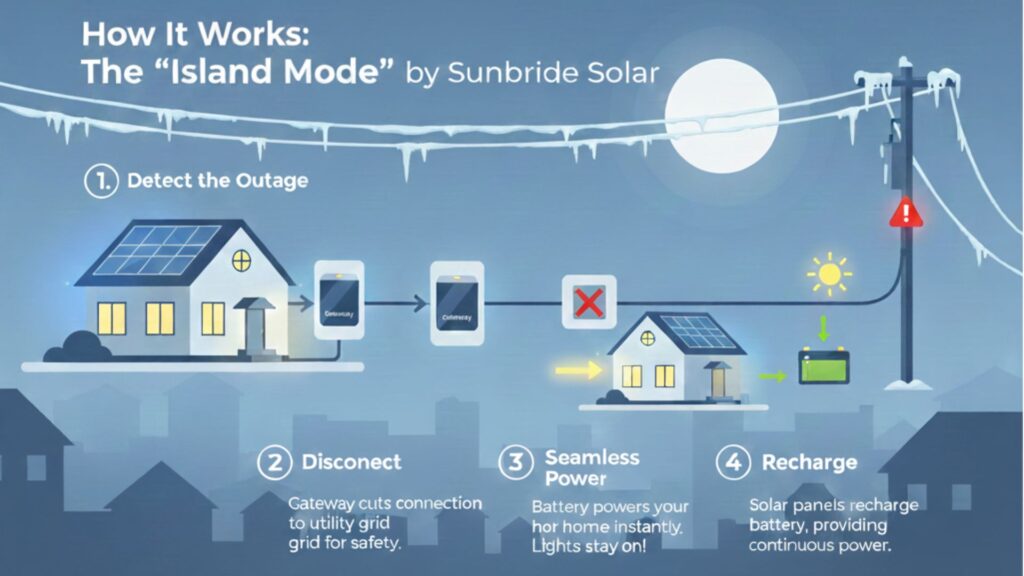
How It Works: The “Island Mode”
When the grid fails, your system performs a seamless maneuver known as “islanding.”
- Detect the Outage: The moment the grid voltage drops (due to ice, wind, or accidents), your Gateway detects the failure instantly.
- Disconnect: It automatically cuts the connection to the utility grid. This is crucial—it ensures your solar energy doesn’t back-feed into the lines, keeping utility workers safe as they repair the ice damage.
- Seamless Power: Your battery takes over instantly. You might not even notice the power went out until you look out the window and see the streetlights are dark.
- Recharge: Even if the grid is down for days, your solar panels will continue to recharge the battery during the day (yes, even in cloudy weather), providing indefinite power as long as you manage your usage.
Critical Loads vs. Whole Home Backup
One of the most common questions we get is, “What can I power?” The answer depends on the system size we design for you.
Option 1: Critical Load Backup (Essential Security)
This is the most popular and cost-effective option. We install a “sub-panel” that powers only your most vital circuits.
- What runs: Refrigerator, Wi-Fi router, LED lights in main rooms, charging outlets for phones/laptops, and gas furnace blowers.
- What stays off: Heavy loads like electric dryers, EV chargers, and hot tubs.
- Benefit: Keeps the battery running longer and costs less to install.
Option 2: Whole Home Backup (Total Comfort)
For homeowners who want life to continue as if nothing happened, we can stack multiple batteries (like 2+ Tesla Powerwalls).
- What runs: Everything. You can cook on your electric range, run the heat pump, and wash clothes.
- Benefit: Zero lifestyle compromise.
- Note: This requires a larger battery bank to ensure you don’t drain your reserves too quickly.
Will Solar Charge My Battery in an Ice Storm?
This is a valid concern. The Pacific Northwest is famous for grey winters. However, modern solar technology is surprisingly resilient.
- Diffused Light: Solar panels do not need direct, hot sunlight to work. They rely on UV light, which penetrates cloud cover. While production is lower than in July, it is usually sufficient to keep a battery “topped off” for essential needs.
- Cold Efficiency: Electronics actually love the cold. Solar panels operate more efficiently in low temperatures than in extreme heat.
- Snow Shedding: As soon as a small portion of the panel is exposed or warms up from internal resistance, the snow/ice tends to slide off the sleek glass surface much faster than it melts off asphalt shingles.
More Than Just a Backup
While security during a blackout is the primary benefit, a battery backup system works for you every single day.
- Peak Shaving: If your utility (like PGE or Pacific Power) charges higher rates during “peak” hours (usually 5 PM – 9 PM), your battery can power your home during those times, avoiding peak pricing.
- Grid Independence: You become less reliant on aging infrastructure. You produce your power, store it, and use it on your terms.
The Clear Financial Case (ROI)
Investing in a battery is a sound financial decision. We help you navigate the complex web of federal and local incentives to maximize your return.
ROI Example: Washington Homeowner (10kW Solar + Battery) Estimates based on typical installations. Your exact savings will vary.
| Financial Aspect | Cost / Savings | Description |
| Gross System Cost | -$40,000 | High-quality solar array + Tesla Powerwall (or similar). |
| Federal Tax Credit | +$12,000 | The 30% Solar Investment Tax Credit (ITC). |
| WA Sales Tax Exemption | +$4,000 | WA exempts solar/battery from sales tax (huge savings!). |
| Net Initial Investment | -$24,000 | Your actual out-of-pocket cost. |
| 20-Year Savings | ~$30,000+ | Estimated bill savings over the life of the system. |
Note: Oregon homeowners have access to the Oregon Solar + Storage Rebate and Energy Trust of Oregon cash incentives, which offer similar competitive value.
Maximizing Your Incentives
We are experts at paperwork so you don’t have to be. We ensure you claim every dollar available to you.
- Federal Solar Tax Credit (ITC): A massive 30% credit on the total cost of your solar and battery system.
- Oregon Solar + Storage Rebate: Income-eligible homeowners can receive cash rebates specifically for adding battery storage.
- Energy Trust of Oregon: As a verified Trade Ally, we unlock exclusive cash incentives for our customers.
- Washington Sales Tax Exemption: 100% sales tax exemption on solar systems (up to 100kW).
The Sunbridge Process: Fast & Turnkey
We know you want this done right and done fast. Our process is refined from 15 years of local experience.
- Free Consultation: We analyze your usage (PGE, Pacific Power, or Clark PUD) to size the perfect battery for your critical loads (fridge, medical devices, lights).
- Permitting: We handle all city permits and HOA approvals.
- Installation: Our in-house crew (no subcontractors!) typically installs in just 2-3 days.
- Peace of Mind: You get a 10-Year Craftsmanship Warranty and 25-Year Product Warranties.
Frequently Asked Questions
Does the battery work in freezing temperatures?
Yes. Most modern batteries (like the Tesla Powerwall) have integrated thermal management systems. They will heat themselves to maintain optimal operating temperatures, ensuring they are ready to discharge power even when it’s freezing outside.
What happens if the battery runs out during a storm?
If your battery hits its reserve limit (usually set to keep a small buffer) and there is no solar production (nighttime), the power will go out. However, as soon as the sun comes up the next morning, the solar panels will wake the system up, recharge the battery, and power will be restored to your home automatically.
Can I add a battery to my existing solar panels?
Yes! This is a very common upgrade (retrofit). We can inspect your current system and integrate a battery so you can finally store the power you produce.
Don’t Wait for the Next Storm
The next major weather event isn’t a matter of if, but when. Secure your home and your family’s comfort today.
Take the first step toward energy security.
Call us at 360-313-7190 or click below to request your free proposal.