
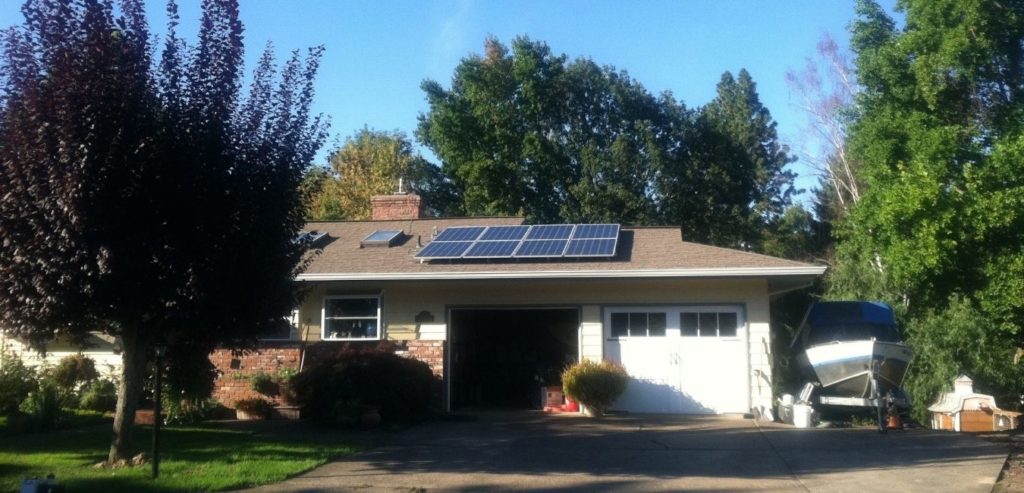
Look outside. If you’re reading this in January in Washougal, Camas, or anywhere along the Columbia River Gorge, it’s probably gray. You might be looking at the drizzle hitting your window and thinking, “Solar panels here? Really? Does that even work?”
We get that question almost every day. It’s a fair one. We aren’t Arizona. We don’t have 300 days of blistering sunshine. But here is the reality: Washington is consistently one of the smartest places in the country to go solar—not despite our weather, but because of our economics.
While we don’t have the strongest cash rebates in the nation, solar is booming here in the Pacific Northwest. Why? Because electricity rates keep climbing, and locking in your own power supply is one of the single most effective financial moves you can make for your home’s future.
If you’re wondering how to make the math work in 2026, this is your plain-English, no-nonsense guide. We’re going to cover everything from the “One Big Beautiful Bill” changes to the nitty-gritty of Clark Public Utilities’ rules.
The 2026 Landscape: Rising Rates & The End of Federal Credits
2026 is a year of transition for the solar industry, and transparency is key. As you may have heard, the landscape changed dramatically last year. The federal tax credit for residential solar was officially retired on December 25, 2025, following the passing of the “One Big Beautiful Bill” in July of 2025.
For years, that tax credit was the headline. A lot of homeowners held off on solar, waiting for the “perfect” time or hoping incentives would get even better. Instead, the federal door closed.
So, is the opportunity gone?
Absolutely not. In fact, for many families, the urgency is higher now than it was five years ago. Here is why:
1. The “Rent vs. Own” Reality The real value of solar in 2026 isn’t about getting a check from the government; it’s about opting out of rate hikes for the next 25 to 30 years. Think of your electricity bill like renting an apartment. You pay every month, you build no equity, and the landlord (the utility company) can raise the rent whenever they want. And as we’ve seen in WA and OR lately, those rates are going up.
When you install solar, you are essentially buying the apartment. You lock in your cost of power. Once the system pays for itself, you are living rent-free electricity-wise.
2. Equipment Costs Have Stabilized While the tax credit is gone, solar technology has continued to get cheaper and more efficient. The panels we install today in Washougal are significantly more powerful than the ones we installed ten years ago, meaning you need fewer of them to produce the same amount of power.
The “Hidden” Incentive: 1:1 Net Metering
If you take only one thing away from this article, let it be this: Net Metering is the financial engine of Washington solar. Even better than a one-time rebate check, this policy affects your budget every single month for decades.
The “Squirrel Strategy”
Here is the best way to visualize how solar works in the Pacific Northwest. Think of your solar system like a squirrel gathering nuts, and the utility grid like a hollow tree.
- Summer (The Gathering Phase): In July and August, the sun is blasting down on Camas. Your days are long, and your panels are producing way more energy than your house actually uses. You can’t use all that power in real-time. So, the excess flows back onto the grid. Your utility meter literally spins backward. The utility company “stores” these credits for you—usually at a generous 1-for-1 retail rate.
- Winter (The Hibernation Phase): Then comes December. The clouds roll in. It gets dark at 4:30 PM. Your panels are producing less, but you’re using more power for heating and lights. That’s okay! You simply draw from the “nuts” (energy credits) you stored up all summer.
You are essentially using July sunshine to power your Christmas lights. This 1:1 exchange is what allows solar to zero out bills in Washington, even with our rainy winters.
The “March 31” Catch (And Why Local Matters)
Here is where the “Cookie-Cutter” national solar companies mess up. In Washington, your bank of energy credits typically resets on March 31st.
If you have 5,000 extra credits sitting in your account on that day, they often expire, and the utility keeps them for free. (It’s a “use it or lose it” system).
An out-of-state installer might try to sell you a massive system to “cover 110% of your bill,” thinking bigger is better. They don’t realize that in Washington, that extra 10% is just a donation to the power company every spring. A local expert knows exactly how to size your system so you maximize your savings without overbuilding. We design for the sweet spot—getting you as close to zero as possible without wasting your money.
Other Financial Helpers in 2026
1. The Sales Tax Exemption
This is a simple, instant savings that often flies under the radar. In Washington, most residential solar installations are exempt from the 6.5% state sales tax.
There is no paperwork for you to file. No waiting for a refund. We simply don’t charge you the tax on the qualifying equipment (panels, inverters, racking). On a typical home improvement project, sales tax adds a huge chunk to the bottom line. With solar, that cost vanishes instantly.
2. Resilience: The “Peace of Mind” Dividend
We all know the drill. The Gorge winds pick up, or a winter ice storm hits, and the lights flicker and die.
While not a “cash” incentive, adding a battery backup (like the Tesla Powerwall or Enphase IQ Battery) is becoming the most popular choice for local families. In 2026, battery tech is smarter than ever.
- Keep the Essentials Running: Keep your fridge cold, your internet router on (crucial for remote workers!), and lights running during an outage.
- Seamless Switch: You often won’t even notice the power went out. The battery takes over in a fraction of a second.
The EV Connection: Driving on Sunshine
You can’t drive five minutes in Vancouver or Portland without seeing an Electric Vehicle (EV). The Pacific Northwest is EV central.
If you own an EV (or are planning to buy one in 2026), solar becomes a “double dip” on savings.
- You stop paying for gas.
- You stop paying the utility company to charge your car.
When you plug your car into a solar-powered home, you are literally driving on sunshine. For many of our customers, the ROI (Return on Investment) of their solar system speeds up drastically when they factor in the $200+ per month they used to spend at the gas pump.
Myth-Busting: “But… It Rains All The Time!”
We need to address the elephant in the room.
Myth: Solar panels need direct, hot sunlight to work. Fact: Solar panels run on UV light, not heat.
Germany is one of the world leaders in solar power, and their climate is very similar to ours—gray, cloudy, and temperate. Modern solar panels are incredibly efficient at capturing “diffuse irradiance” (the light that filters through the clouds).
Yes, your production drops in the winter (that’s why we have Net Metering!). But in the summer, our cooler temperatures actually help. Solar panels lose efficiency when they get too hot. A 75-degree sunny day in Washougal is actually better for peak solar production than a 100-degree day in Phoenix.
The Sunbridge Solar Process: What to Expect
If you decide to explore solar in 2026, here is what the process looks like with a local crew. We handle the paperwork so you don’t have to.
- The Site Survey: We come out (rain or shine) to measure your roof, check your electrical panel, and analyze shade from nearby fir trees.
- Custom Design: We build a 3D model of your home to show you exactly where panels will go and how much energy they will produce. No guesswork.
- Permitting & Paperwork: We handle the city permits and the interconnection applications with Clark Public Utilities or PGE.
- Installation: Most residential jobs take just 2 to 3 days. Our in-house crew (never subcontractors) treats your home with respect. We clean up after ourselves.
- Inspection & Activation: The city inspects the work, the utility company swaps your meter, and we get to flip the switch!
Frequently Asked Questions (Local Edition)
Will solar panels void my roof warranty?
Not if installed correctly. We use industry-standard flashing and mounting systems designed to be watertight. Plus, Sunbridge Solar offers a 10-year workmanship warranty. If there’s a leak caused by our work (which is incredibly rare), we fix it.
I live in an HOA in Camas. Can they stop me?
Generally, no. Washington law strongly protects a homeowner’s right to generate solar energy. While HOAs can place “reasonable” restrictions on aesthetics (like asking for black-on-black panels, which we prefer anyway!), they typically cannot prevent you from installing solar.
What about moss?
Ah, the PNW struggle. Solar panels are glass, so moss doesn’t grow on the panels themselves. In fact, the panels protect the portion of the roof they cover! For the rest of the roof, we recommend standard maintenance.
Is 2026 Your Year?
Solar isn’t a get-rich-quick scheme. It’s a slow, steady, reliable investment in your home and your future. It’s about predictability in an unpredictable world.
We aren’t here to pressure you. We are here to help you run the numbers. If your roof has too much shade, we’ll tell you. If your bill is too low to justify the cost, we’ll tell you that too.
Ready to see the math for yourself? Give us a call at 360-313-7190. We’re your neighbors, we’re verified solar installers, and we’re ready to help you power your life with clean, local energy.