The Truth About False Urgency In Solar Sales
It starts with a knock on the door during dinner, or perhaps an aggressive ad popping up on your social media feed. The message is always the same:
- “The government program is ending!”
- “We have a crew in your neighborhood just for today!”
- “You must sign now to lock in these rates!”
If you have explored going solar in the Pacific Northwest recently, you have likely encountered this pressure. It is designed to make you anxious. It is designed to make you feel like you are losing money every second you hesitate.
But here is the truth about solar sales: Real solar energy is a construction project, not an impulse buy.
At Sunbridge Solar, we believe an educated customer is our best customer. After 15+ years of serving Oregon and Washington, we have seen every trick in the book. Today, we are pulling back the curtain on high-pressure solar sales to help you distinguish between a legitimate deadline and a manipulative sales tactic.
What is “False Urgency”?
False urgency is a psychological trigger used by salespeople to bypass your logical decision-making process. By creating a fear of missing out (FOMO), they hope to force a signature before you have time to research the company, check their reviews, or compare their pricing.
In the solar industry, this often manifests as solar sales pressure warnings that simply aren’t true.
The “Crew in the Neighborhood” Script
The Pitch: “We are already doing an install down the street. If you sign today, we can slot you in and waive the mobilization fee. But I need to know right now.”
The Reality: Legitimate solar companies schedule installations weeks or months in advance. We require permits, utility interconnection approvals, and engineering designs before a single truck rolls out. No reputable installer has a crew “just driving around” looking for extra roofs to work on. This is a fabrication designed to make you feel special and rushed.
The “Government Program Ending” Lie
The Pitch: “The state solar mandate expires this month. You need to sign up to get your free panels before the funding runs out.”
The Reality: This is one of the most pervasive solar sales tactics in Oregon and Washington, and in 2026 it has an added twist. The 30% federal residential tax credit did not get extended. It ended on December 31, 2025. So anyone still knocking on your door urging you to sign tonight to “lock in the 30% credit” is either working from stale material or counting on you not to check. Neither Oregon nor Washington has a mandate that gives you free panels. The state and utility programs that are still available (Washington’s sales tax exemption through 2029, Energy Trust of Oregon incentives, net metering) are not disappearing next week either. Pressure is the tactic. The deadline is usually the fiction.
The Danger of “One-Call Closes”
In the sales world, a “one-call close” is when a salesperson convinces you to sign a contract spanning 25 years during their very first visit.
Why is this dangerous for you?
- No Site Analysis: A salesperson cannot possibly know if solar is right for you without analyzing your roof’s structural integrity, shading from local trees, and your intricate 12-month energy usage history.
- Inflated Pricing: High-pressure companies often charge 10–30% more than the market rate to cover the high commissions of their aggressive sales teams.
- Hidden Fees: When you are rushed, you don’t read the fine print. This is where “Dealer Fees” hide (more on that below).
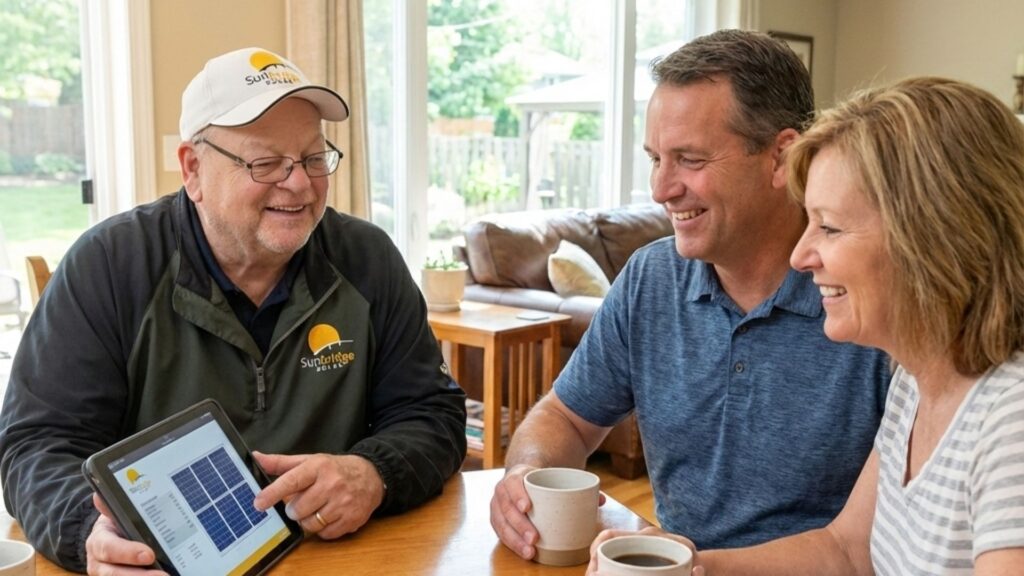
Ethical solar practices dictate that a homeowner should never sign a contract on the first visit. A true professional will gather data, build a custom design, and return to present it to you, leaving you with the proposal to review in private.
The “Low Interest” Trap: Understanding Dealer Fees
One of the darkest secrets in solar sales transparency is the “Dealer Fee” attached to solar loans.
You might see a quote offering a 3.99% interest rate in a market where mortgage rates are 7%. How is this possible?
It is a “buydown.” The lender charges the solar company a massive fee, often 25% to 35% of the total loan amount, to artificially lower the interest rate. The solar company then quietly adds this fee to your total system cost.
Example:
- Cash Price of System: $30,000
- Price with “Low Interest” Loan: $42,000
The salesperson rushes you to sign so you focus on the monthly payment rather than the total amount financed. When you try to pay off the loan early, you realize you owe significantly more than the system is worth.
Honest solar quotes in the PNW will always show you the “Cash Price” separate from the “Financed Price” so you can see exactly what that loan is costing you.
Regional Specifics: Avoid Solar Scams in Washington & Oregon
Scammers often tailor their scripts to local anxieties. Here is what to watch for in our region.
Washington: The “PUD/City Light” Impersonator
We have seen reports of salespeople wearing orange vests and holding tablets, claiming to be “partners” with Snohomish PUD, Puget Sound Energy, or Seattle City Light.
- Fact Check: Utilities never go door-to-door selling solar panels. If they are at your door, they are selling for a private company.
Oregon: The “Energy Trust” Misrepresentation
The Energy Trust of Oregon provides fantastic cash incentives, but they do not employ door-to-door salespeople.
- Fact Check: Only “Trade Ally” contractors (like Sunbridge Solar) are authorized to offer Energy Trust incentives. You can, and should, verify a contractor’s status directly on the Energy Trust website before signing anything.
Your Shield: Solar Consumer Protection Laws
You have more power than you think. Both states have enacted laws to protect you from high-pressure solar sales.
The “Cooling-Off” Rule (Federal & State)
Under the FTC’s Cooling-Off Rule, and reinforced by state laws, you have a three-day right of rescission.
- This means that for any sale made in your home (door-to-door), you have three business days to cancel the contract for a full refund, no questions asked.
- If a salesperson tries to install immediately or demands a non-refundable deposit on the spot, they are breaking the law.
The Washington Solar Consumer Protection Act
Recently passed legislation in Washington adds even more teeth. It requires:
- Transparent disclosure of total system costs.
- Clear explanations of annual production estimates.
- Mandatory licensing for sales representatives.
If a company is hesitating to show you their license or give you a copy of the contract to read before you sign, walk away.
The Checklist: Choosing a Reliable Solar Company
How do you filter out the noise and find a partner who values ethical solar practices? Use this checklist when vetting a potential installer:
- Local Presence: Do they have a physical office in Oregon or Washington? Or are they a “national dealer” who will subcontract the work to the lowest bidder?
- Verification: Are they an Energy Trust of Oregon Trade Ally? (This is a gold standard for quality verification).
- Experience: How long have they been in business? Sunbridge Solar has 15+ years of experience. Avoid “pop-up” companies that have existed for less than two years.
- No-Pressure Process: Do they encourage you to get other quotes? A confident company knows their value and isn’t afraid of competition.
- Transparent Warranties: Do they offer a craftsmanship warranty? We stand by our work for 10 years, in addition to the 25-year manufacturer warranties.
Takeaway: Take Your Time. It’s Your Home.
A solar investment is one of the smartest financial decisions you can make for your home or business. It increases your property value, lowers your overhead, and protects the environment.
But it is a decision that deserves respect, calculation, and patience.
If you feel a knot in your stomach because a salesperson is pushing you to sign right now, trust your gut. That is false urgency.
At Sunbridge Solar, our goal isn’t to “close” you; it is to empower you. We provide honest solar quotes in the PNW that stand up to scrutiny. We want you to be as happy with your system in Year 15 as you are on Day 1.
Don’t let pressure dictate your power.
Call us at 360-313-7190. We promise: No pressure, no false deadlines, just expert advice from your local solar neighbors.