
Hyundai Heavy Industries
Hyundai Heavy Industries is well-known for manufacturing cars, but they are increasingly gaining popularity for their solar panels. Hyundai Green Energy has been part of the solar panel industry since 2005, although it has only recently re-entered the North American market. In this article, we’ll take a look at all of the different types of panels that Hyundai currently offers as well as how they stack up to other solar panels.
What Are The Different Types Of Hyundai Solar Panels?
There are currently five different series of solar panels offered by Hyundai.
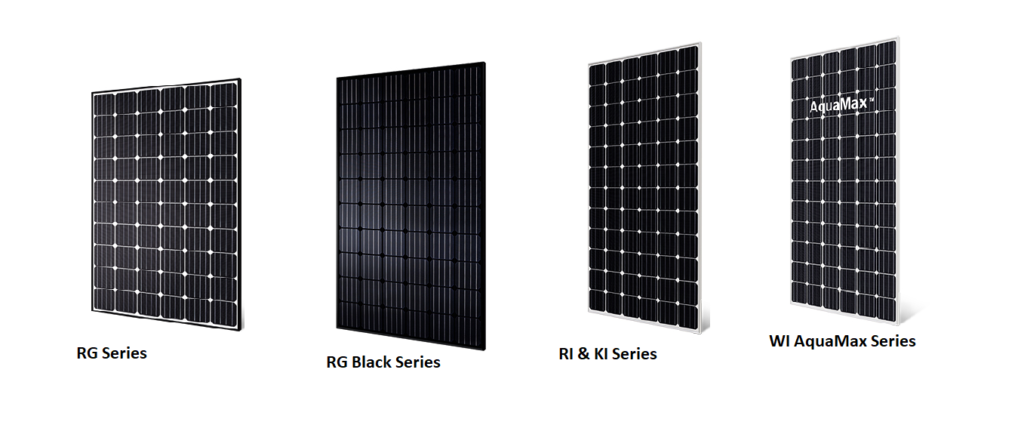
RG Series
The RG series encompasses four different models with wattage options of 295w, 300w, 305w, and 310w. These panels are made with 60 cells of monocrystalline silicon and they can be used for either residential or commercial systems. The RG series panels utilize advanced PERL technology that makes them higher efficiency and able to generate significant amounts of solar power even in low-light conditions.
While the efficiency rating varies slightly based on the exact model, the RG series panels offer up to 18.9% efficiency. These panels do not use LID or PID, so they can offer a higher energy yield throughout their entire lifespan. RG series panels are built to be tough, durable, and resistant to corrosion. Hyundai guarantees the quality and safety of all their products after they are tested in their UL and VDE accredited laboratory.
RG Black Series
The RG Black series also includes four different models with wattages of 290w, 295w, 300w, and 305w. The all-black design of these panels gives them a very sleek appearance and makes them best-suited for residential applications since the panels can blend in more easily to a dark-colored roof. These aesthetically pleasing panels also use PERL technology for maximally efficient power generation in low-light situations.
These panels are quite similar to the RG series, but their efficiency rating is slightly lower at around 17.7%. They also forgo LID and PID for a higher lifetime yield of power and they are built to last. Like all of Hyundai’s panels, they are tested extensively at their UL and VDE accredited laboratory.
RI Series
The RI series panels utilize 72 cells of monocrystalline silicon and the series includes six models:
- 345w
- 350w
- 355w
- 360w
- 365w
- and 370w
These massive panels are designed for commercial and utility solar energy systems. They offer an efficiency rating of around 18.9% and like the rest of Hyundai’s panels, they use PERL technology but do not have LID or PID, and of course, they are guaranteed safety and quality.
KI Series
The KI series panels are also 72 cells of monocrystalline silicon. These panels are designed specifically for utility purposes and they can handle a maximum system voltage of 1,500 V, which helps reduce the balance of system (BOS) costs for utility companies.
This series contains eight different models with the following wattages:
- 345w
- 350w
- 355w
- 360w
- 365w
- 370w
- 375w
- and 380w
These panels can deliver up to 19.4% efficiency, and, as always, they are durable, use efficient technology, and are tested extensively for safety and quality.
WI AquaMax Series
The WI AquaMax series panels are meant for floating solar energy plants, and as such, they are designed to be highly resistant to water and corrosion. These panels can be combined into systems with a maximum voltage of 1,000 V and they offer an efficiency rating of up to 18.9%.
How do Hyundai Solar Panels compare to the Competition?
There are several metrics that we need to look at to compare Hyundai solar panels with panels from other manufacturers. Let’s break them down.
How Efficient Are Hyundai Solar Panels?
Solar panel efficiency refers to the percentage of sunlight that hits the panel that is converted into electricity, and for silicon-based panels that are widely used in residential and commercial applications, the average range is between 14-22%.
As a general rule, the higher the wattage per panel, the higher the percentage of efficiency as well. Hyundai’s panels have efficiency ratings of 17.2-19.4%, which places them squarely in the middle of the range. Their highest efficiency residential panel offers 18.9% efficiency while their best utility panel offers 19.4%.
What Is The Temperature Coefficient?
The temperature coefficient of a solar panel refers to how much power the panel loses as the temperatures increase, which has a direct influence on the power output. Temperature coefficients are expressed as a percentage of a decrease per degree Celsius and generally apply only when the temperature exceeds 25 degrees Celsius or about 77 degrees Fahrenheit. Temperatures lower than those are unlikely to have an effect on the efficiency of solar panels.
Hyundai’s panels have temperature coefficients that range between -0.42 and -0.39% per degree Celsius. That means that for each one-degree increase over 25 Celsius, their panels will lose between 0.39% and 0.42% of their efficiency rating, which as we mentioned above is 17.2-19.4%.
Naturally, you want the temperature coefficient to be as low as possible for the best output throughout the year. On average, monocrystalline solar cells have an average temperature coefficient of -0.38% per degree Celsius and polycrystalline cells are a bit higher at -0.41% per degree Celsius. Since all of Hyundai’s panels are monocrystalline, they all fall just a bit short of the average temperature coefficient.
What Is Power Rating?
All solar panels also have a power rating, which tells the amount of power in watts that they produce under standardized testing conditions. Most solar panels available today range between 200 and 350 watts, and Hyundai panels offer between 295 and 380 watts, which places them at the higher end of the power scale and makes them appropriate for residential as well as commercial and utility usage.
How Much Do Hyundai Solar Panels Cost?
Cost and how to calculate costs is often one of the biggest deciding factors for consumers who are choosing which solar panels they want to install. Of course, the total cost of the system depends on more than just the cost of the panels alone – permit fees, mounting brackets, inverters, installation costs, and so forth must also be factored in. However, the per-watt price of solar panels is a good reference point.
The average cost per watt for solar panels in the United States is between $2.71 and $3.31. Hyundai panels are priced between $2.75 and $3.15, which puts them at the less expensive end of the scale. Based on that range, the average 6 kW solar energy system with Hyundai solar panels will cost between $15,700 and $23,900. However, this is a gross price that does not reflect any tax credits, incentives, or individualized estimates for specific home layouts.
By applying various federal, state, and local solar incentives, it’s possible to cut the cost of a solar energy system installation nearly in half, so realistically the net cost to install a Hyundai array could be closer to the $10,000 to $15,000 range. Just the 26% federal investment tax credit alone can drop the price to anywhere from $11,082 to $17,786, and you can often take advantage of rebates, net metering, property tax exemptions, and so forth to further drop the overall price.
While Hyundai panels don’t offer the pinnacle of technology, efficiency, or performance, they are very reasonably priced and present an excellent mid-range option. At Sunbridge Solar, we offer a very competitive price for Hyundai solar panels as part of a home or commercial solar energy system.
Hyundai Solar Panel Warranty
For something as long-lasting as solar panels, warranties are a critical factor when selecting specific products. Most solar panel manufacturers offer material warranties that cover failures resulting from manufacturing defects or environmental issues. Some high-end solar panel manufacturers offer material warranties of up to 25 years, but Hyundai offers just a 12-year warranty on their newer panels and a 10-year warranty on older models.
In addition to material warranties, solar manufacturers also usually offer performance warranties, which guarantee the power output of their panels after certain periods of time. Hyundai offers a 30-year performance warranty, which helps compensate for the shorter material warranty. Often, if something is going to go wrong with a panel as a result of a manufacturing defect, it will happen or become apparent relatively soon after installation. Plus, having a guarantee of the power output of the panels for 30 years is a reassuring factor.
Are Hyundai Solar Panels Right For Me?
If you are interested in Hyundai solar panels for your home or business, get in touch with our solar experts at Sunbridge Solar today! We will be more than happy to discuss your solar goals in a free consultation and provide a project quote for installing Hyundai solar panels.
Our solar advisors will help you decide whether Hyundai panels are right for your situation and assist you with sizing your system appropriately.